

Is your lower back pain caused from Lumbar stenosis
Lumbar Spinal Stenosis Treatment: Common Symptoms and How Physical Therapy Can Help You Avoid Surgery
If you have pain, numbness, or heaviness in your lower back or legs when standing or walking, you may be dealing with lumbar spinal stenosis.
This condition is one of the most common causes of lower back and leg pain in adults over 50. Many people are told they need injections, pain medications, or even surgery. In reality, most cases improve with the right physical therapy program and conservative treatment.
At Somersworth Physical Therapy, we help patients with lumbar spinal stenosis reduce pain, improve walking tolerance, and get back to daily activities without relying on surgery or medications.
What Is Lumbar Spinal Stenosis?
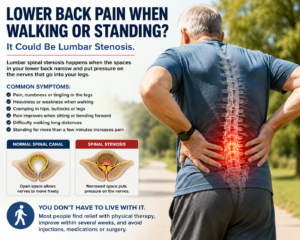
Lumbar spinal stenosis occurs when the spaces in the lower spine narrow and place pressure on the nerves traveling into the legs.
This narrowing usually develops gradually from age-related changes such as:
- Arthritis
- Disc degeneration
- Thickened ligaments
- Bone spurs
- Degenerative disc disease
The condition can irritate or compress nerves in the low back, causing symptoms into the hips, buttocks, and legs.
Common Symptoms of Lumbar Spinal Stenosis
Many patients think they simply “have bad circulation” or “getting older.” The symptoms are actually very specific.
Common lumbar spinal stenosis symptoms include:
- Lower back pain
- Pain that travels into the buttocks or legs
- Numbness or tingling in the legs
- Heaviness or weakness in the legs
- Cramping while walking
- Difficulty standing for long periods
- Pain that improves when sitting
- Relief when leaning forward on a shopping cart
- Trouble walking long distances
- Stiffness in the lower back
One of the biggest clues is this:
Patients often feel worse standing upright and better bending forward.
That happens because bending forward temporarily creates more space around the irritated nerves.
Why Lumbar Spinal Stenosis Gets Worse
Most people unknowingly avoid movement because they are afraid they are damaging their spine.
That usually backfires.
When movement decreases:
- The hips become stiff
- Core muscles weaken
- Walking mechanics worsen
- Balance declines
- Back muscles tighten
- Nerve irritation increases
The result is often more pain and less mobility.
How Physical Therapy Helps Lumbar Spinal Stenosis
Physical therapy is considered one of the best first-line treatments for lumbar spinal stenosis.
A good treatment plan focuses on reducing nerve irritation, improving mobility, and restoring strength without aggravating symptoms.
At Somersworth Physical Therapy, treatment may include:
- Hands-on manual therapy
- Stretching tight hip and spinal muscles
- Core strengthening
- Flexibility exercises
- Walking progression programs
- Postural training
- Joint mobilization techniques
- Balance training
- Dry needling
- Soft tissue work
- Customized home exercise programs
The goal is simple:
Help you walk farther, stand longer, and move with less pain.
Most Patients Improve Within Several Weeks
One of the biggest misconceptions about lumbar spinal stenosis is that it automatically leads to surgery.
That is simply not true.
Most patients begin noticing improvement within several weeks of consistent physical therapy treatment.
Many people can:
- Walk longer distances
- Sleep better
- Return to golf or pickleball
- Shop without leaning on the cart
- Stand with less pain
- Reduce numbness and tingling
- Avoid injections and surgery
The earlier treatment starts, the easier it usually is to calm symptoms down.
Do You Need an MRI for Lumbar Spinal Stenosis?
Not always.
Many patients improve based on clinical evaluation and physical therapy alone.
Research has shown that imaging findings do not always match pain levels. Some people have severe stenosis on MRI and little pain, while others have moderate narrowing and significant symptoms.
Physical therapy is often recommended before considering expensive imaging, injections, or surgery.
When Should You See a Physical Therapist?
You should consider a physical therapy evaluation if:
- Walking is becoming difficult
- Your legs feel heavy or weak
- Standing increases pain
- You avoid activities because of back or leg symptoms
- You feel stiff and less mobile
- You want to avoid surgery or injections
In New Hampshire and Maine, you can start physical therapy without a physician referral.
Physical Therapy for Lumbar Spinal Stenosis in New Hampshire and Maine
At Somersworth Physical Therapy, our team specializes in treating lower back and nerve-related conditions using evidence-based physical therapy treatments.
We work with patients every day who thought surgery was their only option and help them return to normal activities naturally.
If lumbar spinal stenosis is limiting your life, physical therapy may be the first and best step toward relief.
Somersworth Physical Therapy is a proud member of Pinnacle Rehab Network