




Pickleball is one of the fastest-growing sports in the country, and for good reason. It is fun, social, competitive, and easier to pick up than many other sports.
But here is the problem.
A lot of people jump into pickleball without preparing their body for the quick stops, pivots, lunges, reaching, and overhead shots the game demands. That is when injuries start showing up.
At Somersworth Physical Therapy, we see pickleball-related injuries in the shoulder, elbow, knee, ankle, Achilles, hip, and low back. The good news is that many of these injuries can be prevented with a proper warm-up, mobility work, and strength training.
Why Pickleball Injuries Happen
Pickleball may look low-impact, but your body has to react fast. One second you are standing still, the next you are lunging for a dink, backpedaling for a lob, or rotating hard for a shot.
Common reasons injuries happen include:
- Not warming up before play
- Poor balance or footwork
- Limited hip, ankle, or shoulder mobility
- Weak glutes, core, or legs
- Overplaying without enough recovery
- Using poor mechanics on repetitive shots
- Trying to play like you are 25 when your knees know the truth
The goal is not to play less. The goal is to prepare your body so you can play better and longer.
Common Pickleball Injuries
Pickleball can lead to several common overuse and sudden-movement injuries.
Shoulder pain- Reaching, serving, and overhead shots can irritate the rotator cuff or cause shoulder impingement. This is especially common if your shoulder mobility or strength is limited.
Tennis elbow or pickleball elbow –Repetitive gripping, backhands, and wrist-heavy swings can overload the tendons on the outside of the elbow.
Knee pain- Quick side-to-side movements, lunges, and repeated squatting can stress the kneecap, meniscus, or surrounding tendons.
Achilles tendinitis- Sudden starts, stops, and pushing off the toes can irritate the Achilles tendon, especially if your calves are tight or weak.
Ankle sprains- Changing direction quickly can cause the ankle to roll, especially if balance or ankle strength is poor.
Low back pain –Rotating, reaching, and bending repeatedly can irritate the low back, especially if your hips are stiff or your core is not doing its job.
Why Warming Up Matters Before Pickleball
Walking onto the court cold is asking your body to go from zero to chaos.
A good warm-up helps increase blood flow, loosen joints, activate muscles, improve balance, and prepare your body for quick movement. Static stretching alone is not enough. You need dynamic movement that mimics what you will do during the game.
A proper warm-up should take about 5 to 10 minutes. That is a small price to pay compared to missing 4 to 6 weeks because your calf decided to quit on you.
Pickleball Warm-Up Exercises
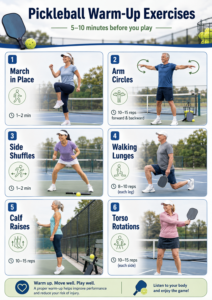
Try these before you play.
- Marching or light jogging in place
Do this for 1 to 2 minutes.
This gets your heart rate up and increases blood flow to your legs.
- Arm circles
Do 10 circles forward and 10 backward.
This helps warm up the shoulders before serving, reaching, and overhead shots.
- Side shuffles
Do 2 to 3 rounds across the court.
Stay low and move side to side like you would during a rally. This prepares your hips, knees, and ankles for quick lateral movement.
- Walking lunges
Do 10 total reps.
Keep your chest tall and step under control. This helps prepare your hips, quads, glutes, and knees.
- Calf raises
Do 15 to 20 reps.
This helps wake up the calves and Achilles before quick push-offs.
- Torso rotations
Do 10 reps each direction.
Rotate through your upper back and hips. This prepares your body for serving and hitting.
- Mini practice rallies
Start slow for 2 to 3 minutes.
Do not make your first swing of the day a full-speed winner attempt. Ease into it.
Strength Exercises to Help Prevent Pickleball Injuries
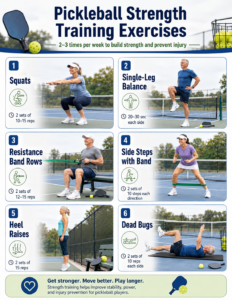
A warm-up helps before you play. Strength training helps keep you playing over time.
Here are a few simple exercises that can help.
- Squats
Builds strength in the quads, glutes, and hips.
Do 2 sets of 10 to 15 reps.
- Single-leg balance
Improves ankle stability and balance.
Stand on one leg for 20 to 30 seconds. Make it harder by turning your head side to side.
- Resistance band rows
Strengthens the upper back and shoulders.
Do 2 sets of 12 to 15 reps.
- Side steps with a resistance band
Strengthens the hips and helps with side-to-side court movement.
Do 2 sets of 10 steps each direction.
- Heel raises
Strengthens the calves and Achilles tendon.
Do 2 sets of 15 reps.
- Dead bugs
Improves core control and helps reduce stress on the low back.
Do 2 sets of 10 reps each side.
Tips to Prevent Pickleball Injuries
- Warm up for 5 to 10 minutes before playing.
- Wear court shoes, not running shoes. Running shoes are made for forward motion. Pickleball requires side-to-side movement.
- Avoid backpedaling too much. Turn and move instead. Backpedaling is where a lot of falls happen.
- Do not ignore pain that gets worse as you play.
- Build up your playing time gradually, especially if you are new to the sport.
- Stretch after playing, especially your calves, hips, shoulders, and forearms.
- Add strength training 2 to 3 times per week.
- Listen to your body. It is not being dramatic. Well, sometimes it is, but pain still matters.
When Should You See a Physical Therapist?
You should see a physical therapist if pain lasts more than a few days, keeps coming back, changes how you move, or limits your ability to play.
Physical therapy can help identify why the pain started in the first place. We look at strength, mobility, balance, footwork, joint motion, and movement mechanics. Then we build a plan to help you recover and prevent the same issue from coming back.
At Somersworth Physical Therapy, we help pickleball players recover from injuries and improve how they move on the court. Whether you are dealing with shoulder pain, elbow pain, knee pain, Achilles pain, or low back pain, physical therapy can help you return to play safely.
Final Takeaway
Pickleball is a great sport, but your body needs to be ready for it.
A simple warm-up, better mobility, and basic strength work can make a big difference in preventing injury. You do not need a complicated routine. You just need to be consistent.
Take care of your body before the match, and your body is less likely to make you regret that third game.
Somersworth PT is a partner of Pinnacle Rehab Network