



Why Warming Up and Stretching Before Golf Can Save Your Swing, And Your Back
Golf may not look like a contact sport, but your body disagrees.
A golf swing is a fast, powerful movement that asks your hips, spine, shoulders, and core to work together in a very short amount of time. If you walk straight from your car to the first tee and start swinging full speed, your body is not ready. That is when tight backs, sore shoulders, stiff hips, and pulled muscles show up.
A proper golf warm-up does not need to take 30 minutes. Even 5 to 10 minutes can help you move better, swing smoother, and reduce your risk of injury.
Why Golfers Should Warm Up Before Playing
Most golf injuries happen because the body is not prepared for rotation. The golf swing requires mobility through the hips, mid-back, shoulders, and neck. When one area is tight, another area usually has to compensate.
For example, if your hips are stiff, your low back may rotate more than it should. That can lead to low back pain during or after your round.
A good warm-up helps:
Improve blood flow to muscles
Increase flexibility and mobility
Improve shoulder, hip, and spine rotation
Prepare your body for faster swing speed
Reduce risk of low back, shoulder, elbow, and hip injuries
Help you feel less stiff on the first few holes
Let’s be honest, using the first three holes as your warm-up is a bad strategy. Your scorecard knows it too.
Stretching vs. Warming Up: What’s the Difference?
Stretching and warming up are not exactly the same thing.
A warm-up gets your body moving and increases blood flow. This should be active.
Stretching helps improve mobility and reduce tightness. Before golf, dynamic stretching is usually best. That means controlled movement through a range of motion instead of holding one position for a long time.
Save long static stretches for after your round or later in the day.
Common Golf Areas That Get Tight
Golfers often struggle with stiffness in these areas:
Hips
Hamstrings
Low back
Thoracic spine, which is your mid-back
Shoulders
Forearms and wrists
If these areas do not move well, your swing can become less efficient. You may lose power, consistency, and comfort.
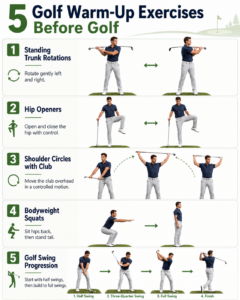
5 Easy Golf Warm-Up Exercises
Try these before your next round or practice session.
1. Standing Trunk Rotations
Stand tall with your feet shoulder-width apart. Hold a golf club across your chest or shoulders. Slowly rotate your upper body side to side.
Do 10 to 15 rotations each way.
This helps loosen your spine and prepare your body for the turning motion of the golf swing.
2. Hip Openers
Stand on one leg while holding onto a golf cart, wall, or club for balance. Lift one knee up and rotate it outward like you are opening a gate. Then reverse the motion.
Do 10 reps each direction per leg.
This helps improve hip mobility, which can reduce stress on the low back.
3. Shoulder Circles with Club
Hold a golf club with both hands in front of you. Slowly raise it overhead as far as comfortable, then lower it back down. Keep the movement controlled.
Do 10 to 12 reps.
This helps warm up the shoulders and upper back before swinging.
4. Bodyweight Squats
Stand with feet shoulder-width apart. Sit your hips back like you are lowering into a chair, then stand back up.
Do 10 to 15 reps.
This activates your legs and glutes, which help create power during your swing.
5. Golf Swing Progression
Start with small, easy half swings. Gradually build up to three-quarter swings, then full swings.
Do 10 to 15 swings total.
Do not make your first swing of the day a full driver rip. That is how backs file complaints.
When Should You Stretch?
Before golf, focus on movement-based stretching and warm-up drills.
After golf, use longer stretches to help reduce stiffness. This is a good time to stretch your hamstrings, hips, low back, chest, and shoulders.
Holding stretches for 20 to 30 seconds after your round can help improve flexibility over time.
What If You Still Feel Tight or Have Pain?
Some stiffness before golf is normal. Pain is not.
If you notice pain in your low back, shoulder, elbow, hip, or knee during or after golf, your body may not be moving the way it should. Physical therapy can help identify the cause and improve your mobility, strength, and swing mechanics.
At Somersworth Physical Therapy, we help golfers improve mobility, reduce pain, and stay active on the course. Whether you are dealing with back pain, shoulder tightness, golfer’s elbow, or just want to move better, our team can help you build a plan that fits your game.
Here is a list of our manual therapy for golf treatments
Final Thought
A short warm-up can make a big difference in how you feel and how you play. Before your next round, take 5 to 10 minutes to get your body ready.
Your back, shoulders, hips, and scorecard will thank you.
Frequently Asked Questions
Should I stretch before golfing?
Yes, but focus on dynamic stretching before golf. This means moving through controlled motions instead of holding long stretches.
How long should I warm up before golf?
Most golfers benefit from a 5 to 10 minute warm-up before playing or practicing.
What is the best warm-up for golf?
The best warm-up includes hip mobility, trunk rotation, shoulder movement, leg activation, and easy practice swings.
Can warming up help prevent golf injuries?
Yes. Warming up prepares your muscles and joints for the demands of the golf swing and may reduce injury risk.
Why does my back hurt after golf?
Back pain after golf often comes from limited hip mobility, poor core control, stiffness in the mid-back, or over-rotation through the low back. A physical therapist can help identify what is causing your pain.
Somersworth PT is a member Pinnacle Rehab Network