

Dry Needling in Physical Therapy: What It Is, How It Works, and Why Patients Choose Somersworth Physical Therapy
If you are dealing with tight muscles, ongoing pain, headaches, or injuries that just will not calm down, dry needling may be one of the most effective treatments available in physical therapy.
At Somersworth Physical Therapy, dry needling has become one of the most requested treatments for patients dealing with muscle pain, sports injuries, neck pain, back pain, tendonitis, and chronic tightness.
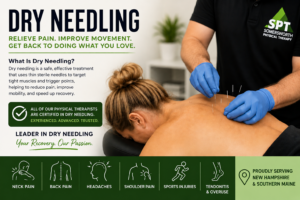
Our team has extensive training in dry needling techniques, and every physical therapist at Somersworth Physical Therapy is certified in dry needling. We have become a regional leader in advanced dry needling treatment throughout the Seacoast area of New Hampshire and Maine.
What Is Dry Needling?
Dry needling is a treatment performed by specially trained physical therapists using very thin sterile needles that are inserted into tight muscles, trigger points, or irritated tissue.
The goal is to:
- Reduce muscle tension
- Improve blood flow
- Decrease pain
- Improve movement
- Help injured tissue heal faster
Despite the name, there is no medication or injection involved. The needle itself creates a response within the muscle and nervous system to help the body reset and heal.
Many patients notice:
- Less pain
- Improved flexibility
- Better movement
- Reduced muscle spasms
- Faster recovery from injuries
How Does Dry Needling Work?
When muscles become tight or injured, they can develop painful trigger points. These trigger points may:
- Cause localized pain
- Refer pain into other areas
- Limit motion
- Create weakness or stiffness
Dry needling helps release these tight areas and improves how the muscle functions.
The treatment often creates a quick muscle twitch response. That twitch is a sign the muscle is relaxing.
This can help:
- Reduce inflammation
- Improve circulation
- Decrease nerve sensitivity
- Restore normal muscle activation
What Conditions Can Dry Needling Help?
Dry needling is commonly used for:
Neck Pain
Tight muscles in the neck and shoulders commonly contribute to:
- Stiffness
- Headaches
- Pain turning the head
- Muscle tension from desk work
Back Pain
Dry needling can help relax muscles around the spine and improve movement for patients with:
- Lower back pain
- Muscle spasms
- Sciatica-related tightness
- Chronic back stiffness
Headaches and Migraines
Many headaches originate from trigger points in the neck, jaw, and upper back muscles.
Dry needling can help reduce:
- Tension headaches
- Cervicogenic headaches
- Migraine frequency
Shoulder Pain
Common shoulder conditions treated with dry needling include:
- Rotator cuff pain
- Tendonitis
- Shoulder impingement
- Frozen shoulder
Sports Injuries
Athletes commonly use dry needling to improve:
- Recovery
- Muscle flexibility
- Performance
- Tissue healing
Tendonitis and Overuse Injuries
Dry needling is frequently combined with strengthening exercises for:
- Tennis elbow
- Golfer’s elbow
- Achilles tendonitis
- Plantar fasciitis
How We Use Dry Needling at Somersworth Physical Therapy
At Somersworth Physical Therapy, dry needling is never used as a stand-alone treatment.
We combine it with:
- Manual therapy
- Joint mobilizations
- Corrective exercise
- Strength training
- Movement retraining
- Postural correction
That matters because simply releasing a muscle without fixing the underlying problem usually leads to the pain returning.
Our goal is to:
- Reduce pain quickly
- Improve mobility
- Fix the root cause
- Keep the pain from coming back
Why Patients Choose Somersworth Physical Therapy for Dry Needling
Not all dry needling programs are the same.
At Somersworth Physical Therapy:
- Every physical therapist is certified in dry needling
- We have extensive experience treating orthopedic and sports injuries
- We use evidence-based treatment approaches
- We combine dry needling with full physical therapy care
- We focus on long-term recovery, not temporary relief
Our clinics are known throughout the Seacoast area for advanced hands-on physical therapy and dry needling treatments.
Patients travel from across:
- New Hampshire
- Southern Maine
- The Seacoast region
Because they want experienced clinicians who specialize in treating muscle and joint pain.
Does Dry Needling Hurt?
Most patients tolerate dry needling very well.
You may feel:
- A small pinch
- Muscle twitching
- Mild soreness afterward
The soreness typically lasts 24 to 48 hours and feels similar to a workout.
Many patients actually report immediate relief and improved motion after treatment.
How Many Dry Needling Sessions Do You Need?
This depends on:
- The condition
- How long symptoms have been present
- Activity level
- Overall health
Some patients improve after 1 to 2 visits.
More chronic conditions may require several treatments combined with a full physical therapy plan.
Dry Needling vs Acupuncture
This is a very common question.
Although both use thin needles, the treatments are very different.
Dry needling is based on:
- Anatomy
- Muscle function
- Orthopedic medicine
- Nervous system response
Acupuncture is based on traditional Chinese medicine principles and energy pathways.
Physical therapists use dry needling specifically to improve muscle and movement problems.
Frequently Asked Questions About Dry Needling
What does dry needling help with?
Dry needling helps reduce muscle tightness, pain, headaches, tendonitis, and movement restrictions. It is commonly used for neck pain, back pain, shoulder injuries, sports injuries, and chronic muscle tension.
Is dry needling safe?
Yes. Dry needling is very safe when performed by trained and certified physical therapists using sterile needles and proper medical techniques.
How long does dry needling take to work?
Many patients notice improvement immediately or within 24 to 48 hours after treatment.
Can dry needling help chronic pain?
Yes. Dry needling is commonly used for chronic muscle pain, tension headaches, and long-term orthopedic conditions.
Do I need a referral for dry needling?
No. In most cases, you can start physical therapy and dry needling without a physician referral.
Is dry needling covered by insurance?
Many insurance plans cover dry needling as part of physical therapy treatment, although coverage varies depending on the insurance provider.
Why choose Somersworth Physical Therapy for dry needling?
Somersworth Physical Therapy has become a leader in dry needling treatment throughout the Seacoast region. Every physical therapist on staff is certified in dry needling and combines it with advanced hands-on physical therapy and individualized treatment plans.
Ready to Try Dry Needling?
If muscle pain, stiffness, headaches, or injuries are limiting your life, dry needling may help you recover faster and move better.
The team at Somersworth Physical Therapy specializes in advanced dry needling treatment and orthopedic physical therapy throughout New Hampshire and Southern Maine.
Contact us today to schedule an evaluation and see if dry needling is right for you.
Somersworth Physical Therapy is a proud member of Pinnacle Rehab Network